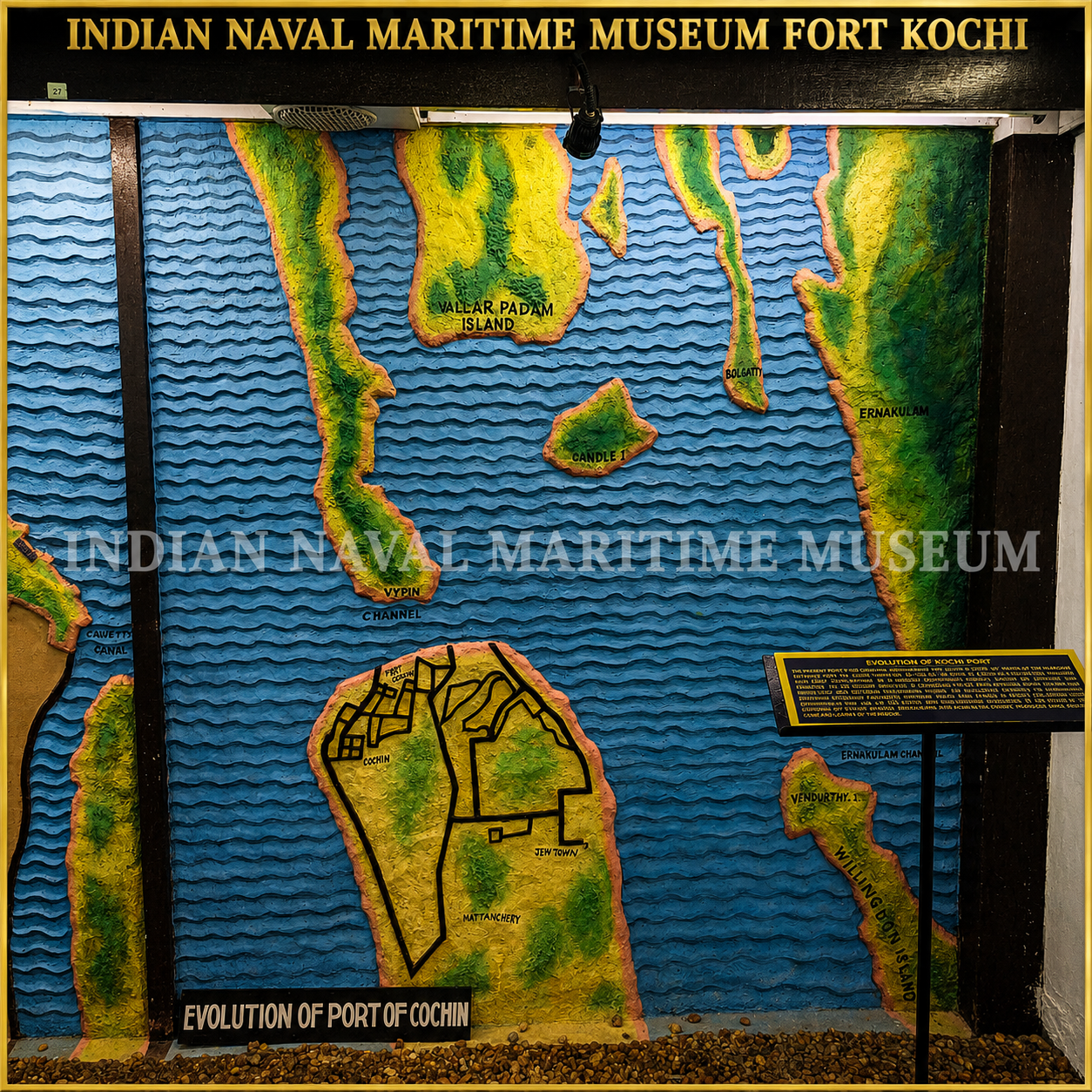
Evolution of Kochi Port
Audio Guide
Listen to artifact story
Audio guide ready
The Evolution of Kochi Port exhibit traces the remarkable transformation of Kochi from a historic coastal trading centre into one of India’s most important modern ports. It highlights the development of the harbour, the influence of European maritime powers, and the engineering achievements that shaped the present-day Port of Kochi.
Early Maritime History
Kochi emerged as a significant trading hub on the Malabar Coast due to its strategic location along major sea trade routes connecting India with the Middle East, Africa, and Europe. The Portuguese and later the Dutch established fortified settlements and trading posts near the harbour entrance, recognizing Kochi’s importance in the spice trade.
Creation of the Modern Harbour
The modern Port of Kochi owes much of its development to Sir Robert Bristow, the British harbour engineer who transformed the natural waterways into a world-class port during the early twentieth century. Through extensive dredging and harbour development projects, he created a safe and navigable deep-water channel capable of accommodating larger ocean-going vessels.
Willingdon Island
One of the most significant outcomes of these engineering works was the creation of Willingdon Island, an artificial island formed using material dredged from the harbour. The island became the administrative and commercial centre of the port and remains a key maritime hub today.
Natural Advantages
Kochi is a naturally protected harbour formed by the extensive backwaters and coastal geography of Kerala. The harbour entrance between Kochi and Vypin provides access to deep inland waters where ships can anchor safely. Even during severe monsoon conditions, the harbour offers protection and operational stability.
Importance of the Port
Today, Kochi Port serves as a major gateway for international trade and maritime activities. It supports commercial shipping, naval operations, passenger traffic, container handling, shipbuilding, and offshore industries. Its strategic location on the Arabian Sea makes it one of India’s most significant maritime centres.
Significance of the Exhibit
This relief depicts the progression from the original Portuguese and Dutch harbour installations to the modern port infrastructure seen today. It showcases how natural geography, maritime trade, and engineering innovation combined to create one of India’s finest natural and man-made harbours.
Key Highlights
Historic Portuguese and Dutch trading settlements at Kochi.
Development of the modern harbour under Sir Robert Bristow.
Creation of Willingdon Island through harbour dredging.
Naturally protected deep-water harbour with extensive backwaters.
One of India’s most important ports for commerce, shipping, and naval operations.
Early Maritime History
Kochi emerged as a significant trading hub on the Malabar Coast due to its strategic location along major sea trade routes connecting India with the Middle East, Africa, and Europe. The Portuguese and later the Dutch established fortified settlements and trading posts near the harbour entrance, recognizing Kochi’s importance in the spice trade.
Creation of the Modern Harbour
The modern Port of Kochi owes much of its development to Sir Robert Bristow, the British harbour engineer who transformed the natural waterways into a world-class port during the early twentieth century. Through extensive dredging and harbour development projects, he created a safe and navigable deep-water channel capable of accommodating larger ocean-going vessels.
Willingdon Island
One of the most significant outcomes of these engineering works was the creation of Willingdon Island, an artificial island formed using material dredged from the harbour. The island became the administrative and commercial centre of the port and remains a key maritime hub today.
Natural Advantages
Kochi is a naturally protected harbour formed by the extensive backwaters and coastal geography of Kerala. The harbour entrance between Kochi and Vypin provides access to deep inland waters where ships can anchor safely. Even during severe monsoon conditions, the harbour offers protection and operational stability.
Importance of the Port
Today, Kochi Port serves as a major gateway for international trade and maritime activities. It supports commercial shipping, naval operations, passenger traffic, container handling, shipbuilding, and offshore industries. Its strategic location on the Arabian Sea makes it one of India’s most significant maritime centres.
Significance of the Exhibit
This relief depicts the progression from the original Portuguese and Dutch harbour installations to the modern port infrastructure seen today. It showcases how natural geography, maritime trade, and engineering innovation combined to create one of India’s finest natural and man-made harbours.
Key Highlights
Historic Portuguese and Dutch trading settlements at Kochi.
Development of the modern harbour under Sir Robert Bristow.
Creation of Willingdon Island through harbour dredging.
Naturally protected deep-water harbour with extensive backwaters.
One of India’s most important ports for commerce, shipping, and naval operations.