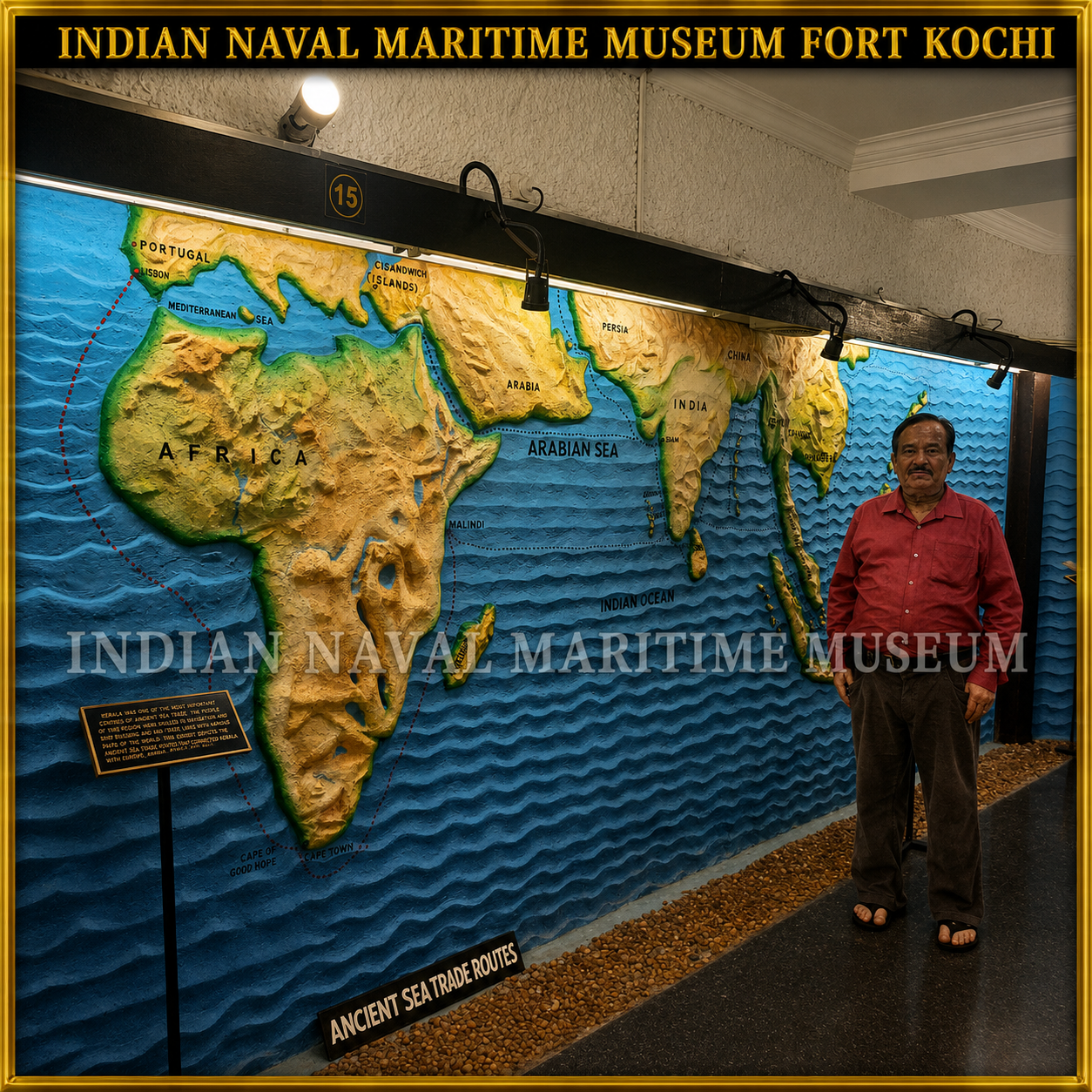
Ancient Sea Trade Routes
Audio Guide
Listen to artifact story
Audio guide ready
This exhibit illustrates the historic maritime routes that connected India with Europe, Arabia, Africa, and East Asia, highlighting the importance of sea trade in shaping world history. The relief primarily depicts the famous voyage of the Portuguese explorer Vasco da Gama, whose successful sea journey to India established a direct maritime link between Europe and the Indian subcontinent.
Vasco da Gama departed from Lisbon, Portugal, on 8 July 1497, sailing around the Cape of Good Hope at the southern tip of Africa before crossing the Indian Ocean. He finally arrived at Calicut (Kozhikode) on 11 May 1498, opening a new chapter in global trade and marking the beginning of direct European maritime involvement in India.
The exhibit also showcases the extensive sea routes used by Arab, Chinese, and European merchants, who had long sailed across the Indian Ocean in search of spices, textiles, precious stones, and other valuable commodities. Calicut served as a major trading hub linking the Middle East, East Africa, Southeast Asia, and China.
These maritime networks facilitated not only the exchange of goods but also the movement of cultures, technologies, religions, and ideas, making Kerala one of the most important centers of international commerce in the medieval world.
Key Highlights
Depicts Vasco da Gama’s historic voyage from Portugal to Calicut.
Shows the sea route around Africa that established direct maritime contact between Europe and India.
Highlights Vasco da Gama’s arrival at Calicut on 11 May 1498.
Illustrates ancient trade networks connecting India with Arabia, Africa, Southeast Asia, and China.
Emphasizes the role of Calicut as a major international trading port.
Demonstrates how maritime trade influenced cultural, economic, and political developments across regions.
Reflects Kerala’s significance as a key center in the Indian Ocean trade network.
Vasco da Gama departed from Lisbon, Portugal, on 8 July 1497, sailing around the Cape of Good Hope at the southern tip of Africa before crossing the Indian Ocean. He finally arrived at Calicut (Kozhikode) on 11 May 1498, opening a new chapter in global trade and marking the beginning of direct European maritime involvement in India.
The exhibit also showcases the extensive sea routes used by Arab, Chinese, and European merchants, who had long sailed across the Indian Ocean in search of spices, textiles, precious stones, and other valuable commodities. Calicut served as a major trading hub linking the Middle East, East Africa, Southeast Asia, and China.
These maritime networks facilitated not only the exchange of goods but also the movement of cultures, technologies, religions, and ideas, making Kerala one of the most important centers of international commerce in the medieval world.
Key Highlights
Depicts Vasco da Gama’s historic voyage from Portugal to Calicut.
Shows the sea route around Africa that established direct maritime contact between Europe and India.
Highlights Vasco da Gama’s arrival at Calicut on 11 May 1498.
Illustrates ancient trade networks connecting India with Arabia, Africa, Southeast Asia, and China.
Emphasizes the role of Calicut as a major international trading port.
Demonstrates how maritime trade influenced cultural, economic, and political developments across regions.
Reflects Kerala’s significance as a key center in the Indian Ocean trade network.