Engine Order Telegraph (EOT) / Engine Room Telegraph
Audio Guide
Listen to artifact story
Audio guide ready
Engine Order Telegraph (EOT) / Engine Room Telegraph
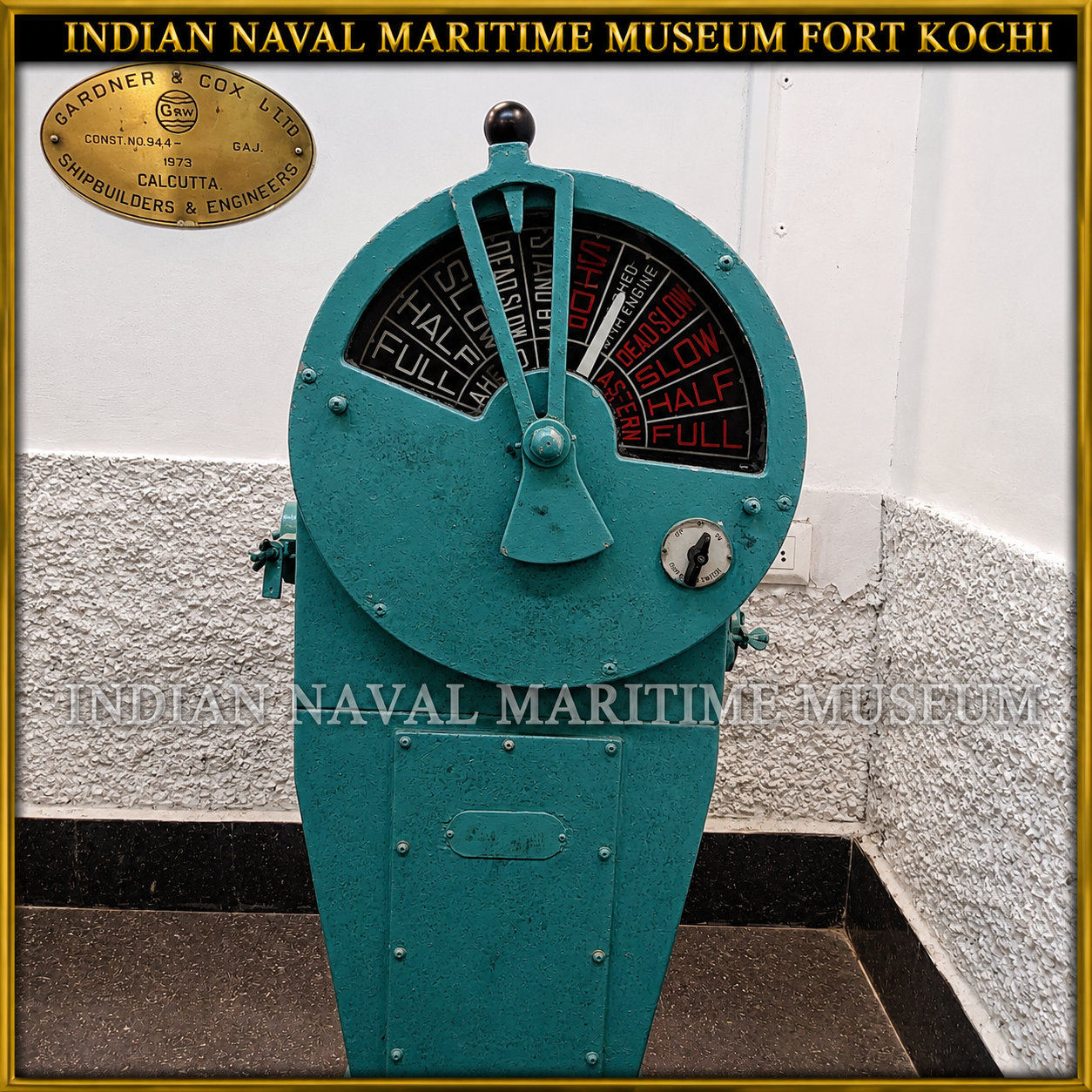
This exhibit is an Engine Order Telegraph, a vital communication device that was traditionally used aboard ships to transmit engine commands between the bridge and the engine room. Before modern electronic control systems, this instrument served as the primary means of conveying speed and maneuvering orders from the ship's captain or officer of the watch to the engineering crew.
The telegraph consists of a lever connected to a dial displaying various engine commands such as Full Ahead, Half Ahead, Slow Ahead, Stop, Stand By, Slow Astern, Half Astern, and Full Astern. When the bridge operator moved the handle to a specific command, a corresponding indicator in the engine room displayed the order, accompanied by a bell or alarm signal. The engineering crew would then acknowledge the command by moving their own telegraph handle to the same position.
The warning plate visible on the exhibit instructs operators to ensure that the transmitter and receiver handles are aligned, highlighting the importance of accurate communication between the bridge and engine room.
Key Features
Mechanical communication system between bridge and engine room.
Used to transmit engine speed and maneuvering commands.
Commands include Ahead, Astern, Stop, and Stand By.
Equipped with acknowledgement mechanism to confirm receipt of orders.
Essential for safe navigation and ship handling.
Widely used on naval and merchant vessels before modern electronic controls.
Historical Significance
The Engine Order Telegraph was one of the most important shipboard communication instruments of the nineteenth and twentieth centuries. It ensured reliable coordination between navigation officers and engineering personnel, particularly during harbor maneuvers, combat situations, and emergency operations. This exhibit represents a significant milestone in the evolution of maritime communication and ship control technology.
This exhibit is an Engine Order Telegraph, a vital communication device that was traditionally used aboard ships to transmit engine commands between the bridge and the engine room. Before modern electronic control systems, this instrument served as the primary means of conveying speed and maneuvering orders from the ship's captain or officer of the watch to the engineering crew.
The telegraph consists of a lever connected to a dial displaying various engine commands such as Full Ahead, Half Ahead, Slow Ahead, Stop, Stand By, Slow Astern, Half Astern, and Full Astern. When the bridge operator moved the handle to a specific command, a corresponding indicator in the engine room displayed the order, accompanied by a bell or alarm signal. The engineering crew would then acknowledge the command by moving their own telegraph handle to the same position.
The warning plate visible on the exhibit instructs operators to ensure that the transmitter and receiver handles are aligned, highlighting the importance of accurate communication between the bridge and engine room.
Key Features
Mechanical communication system between bridge and engine room.
Used to transmit engine speed and maneuvering commands.
Commands include Ahead, Astern, Stop, and Stand By.
Equipped with acknowledgement mechanism to confirm receipt of orders.
Essential for safe navigation and ship handling.
Widely used on naval and merchant vessels before modern electronic controls.
Historical Significance
The Engine Order Telegraph was one of the most important shipboard communication instruments of the nineteenth and twentieth centuries. It ensured reliable coordination between navigation officers and engineering personnel, particularly during harbor maneuvers, combat situations, and emergency operations. This exhibit represents a significant milestone in the evolution of maritime communication and ship control technology.