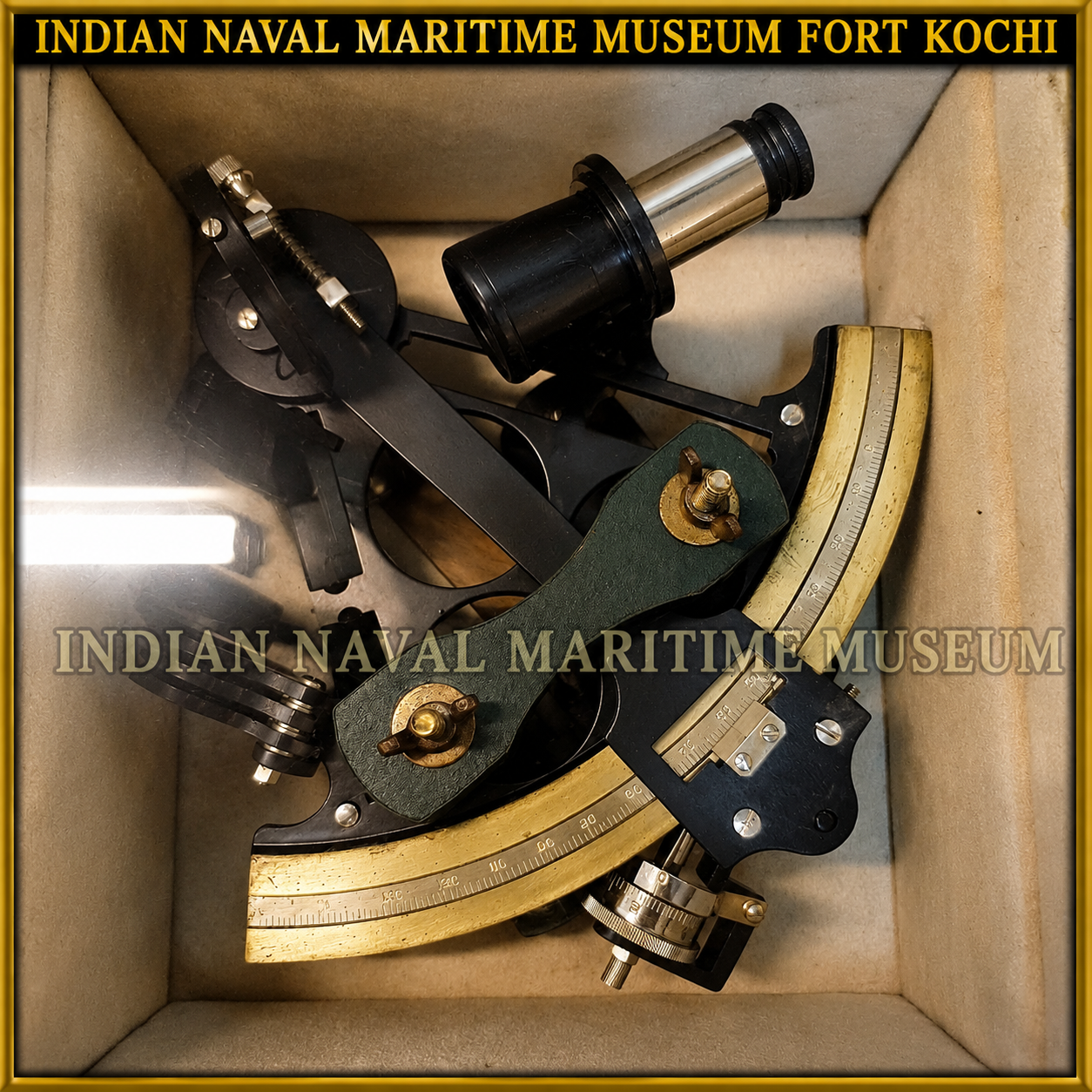
Sextant
Audio Guide
Listen to artifact story
Audio guide ready
The Sextant is one of the most important navigational instruments in maritime history. Before the advent of GPS and modern electronic navigation systems, sailors relied on sextants to determine their position at sea with remarkable accuracy. The instrument measures the angle between a celestial body, such as the Sun, Moon, or stars, and the horizon, enabling navigators to calculate their latitude and longitude.
The sextant derives its name from the Latin word sextus, meaning “one-sixth,” referring to its arc, which spans 60 degrees. Developed during the 18th century, the sextant revolutionized ocean navigation and significantly improved the safety of long-distance sea voyages. By combining observations taken with the sextant and accurate timekeeping from a marine chronometer, navigators could determine their exact position anywhere on the world's oceans.
The instrument consists of a telescope, mirrors, an adjustable index arm, and a graduated scale. By aligning a celestial object with the horizon through a system of mirrors, the navigator obtains an angle measurement that can be used for navigation calculations.
For more than two centuries, sextants served as the primary navigation tool on naval and merchant vessels. Even in the modern era, sextants remain an important backup instrument and continue to be taught as a traditional navigation skill in many navies around the world.
This exhibit highlights the ingenuity and precision of early maritime navigation and showcases an instrument that played a crucial role in global exploration, trade, and naval operations.
The sextant derives its name from the Latin word sextus, meaning “one-sixth,” referring to its arc, which spans 60 degrees. Developed during the 18th century, the sextant revolutionized ocean navigation and significantly improved the safety of long-distance sea voyages. By combining observations taken with the sextant and accurate timekeeping from a marine chronometer, navigators could determine their exact position anywhere on the world's oceans.
The instrument consists of a telescope, mirrors, an adjustable index arm, and a graduated scale. By aligning a celestial object with the horizon through a system of mirrors, the navigator obtains an angle measurement that can be used for navigation calculations.
For more than two centuries, sextants served as the primary navigation tool on naval and merchant vessels. Even in the modern era, sextants remain an important backup instrument and continue to be taught as a traditional navigation skill in many navies around the world.
This exhibit highlights the ingenuity and precision of early maritime navigation and showcases an instrument that played a crucial role in global exploration, trade, and naval operations.