History of the Indian Navy’s Motto
Audio Guide
Listen to artifact story
Audio guide ready
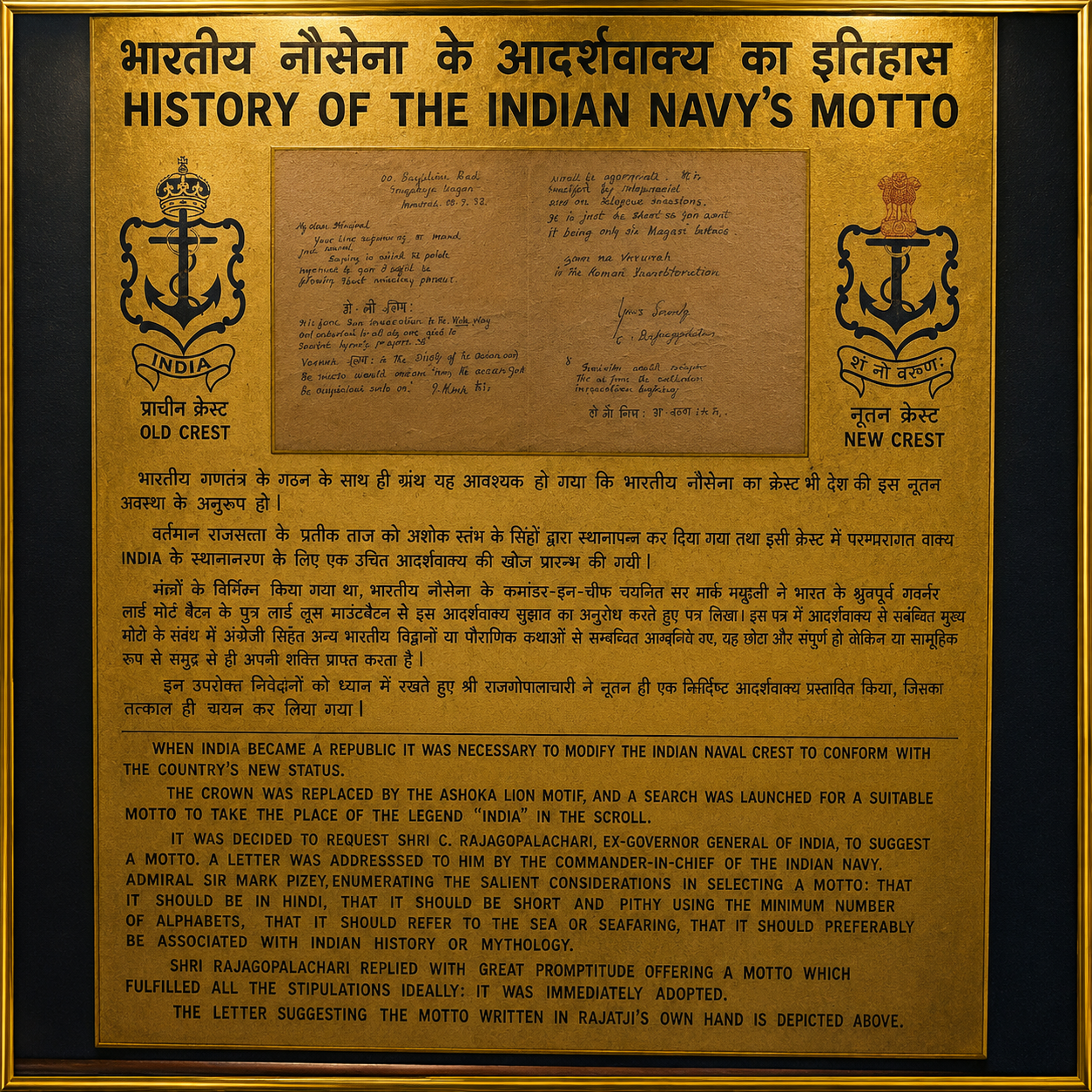
This exhibit explains the origin and evolution of the motto of the Indian Navy following India's transition to a Republic in 1950.
Background
When India became a Republic, it became necessary to modify the Indian Naval Crest to reflect the country's new status. The British Crown, which had appeared on the crest during colonial rule, was replaced with the Ashoka Lion Capital, the national emblem of India. At the same time, the Navy sought a suitable Indian motto to replace the word “INDIA” displayed on the naval crest.
Search for a Motto
The Commander-in-Chief of the Indian Navy, Admiral Sir Mark Pizey, requested C. Rajagopalachari (Rajaji), the last Governor-General of India, to suggest a motto for the Navy. Certain requirements were specified:
The motto should be in Hindi or Sanskrit.
It should be short, meaningful, and easy to remember.
It should reflect the sea, navigation, or maritime traditions.
It should preferably be connected to Indian history, culture, or mythology.
Adoption of the Motto
Rajaji proposed the Sanskrit phrase:
“शं नो वरुणः” (Sham No Varunah)
which translates to:
“May the Lord of the Oceans be auspicious unto us”
or
“May Varuna, the God of the Seas, bless and protect us.”
The phrase is derived from the Taittiriya Upanishad and invokes the blessings of Varuna, the Vedic deity associated with oceans, waters, and navigation.
Significance
The motto perfectly fulfilled all the Navy's requirements:
It is brief and powerful.
It has deep roots in Indian tradition.
It symbolizes the Navy's connection with the sea.
It reflects India's maritime heritage and spiritual values.
Legacy
Since its adoption, “Sham No Varunah” has remained the official motto of the Indian Navy and continues to represent the service's commitment to safeguarding India's maritime interests while seeking the blessings of the Lord of the Oceans.
This exhibit also displays the transition from the Old Naval Crest to the New Naval Crest and includes the original correspondence through which Rajaji suggested the motto that remains in use today.
Background
When India became a Republic, it became necessary to modify the Indian Naval Crest to reflect the country's new status. The British Crown, which had appeared on the crest during colonial rule, was replaced with the Ashoka Lion Capital, the national emblem of India. At the same time, the Navy sought a suitable Indian motto to replace the word “INDIA” displayed on the naval crest.
Search for a Motto
The Commander-in-Chief of the Indian Navy, Admiral Sir Mark Pizey, requested C. Rajagopalachari (Rajaji), the last Governor-General of India, to suggest a motto for the Navy. Certain requirements were specified:
The motto should be in Hindi or Sanskrit.
It should be short, meaningful, and easy to remember.
It should reflect the sea, navigation, or maritime traditions.
It should preferably be connected to Indian history, culture, or mythology.
Adoption of the Motto
Rajaji proposed the Sanskrit phrase:
“शं नो वरुणः” (Sham No Varunah)
which translates to:
“May the Lord of the Oceans be auspicious unto us”
or
“May Varuna, the God of the Seas, bless and protect us.”
The phrase is derived from the Taittiriya Upanishad and invokes the blessings of Varuna, the Vedic deity associated with oceans, waters, and navigation.
Significance
The motto perfectly fulfilled all the Navy's requirements:
It is brief and powerful.
It has deep roots in Indian tradition.
It symbolizes the Navy's connection with the sea.
It reflects India's maritime heritage and spiritual values.
Legacy
Since its adoption, “Sham No Varunah” has remained the official motto of the Indian Navy and continues to represent the service's commitment to safeguarding India's maritime interests while seeking the blessings of the Lord of the Oceans.
This exhibit also displays the transition from the Old Naval Crest to the New Naval Crest and includes the original correspondence through which Rajaji suggested the motto that remains in use today.